¶ Therapeutic Plasma Exchange (TPE)
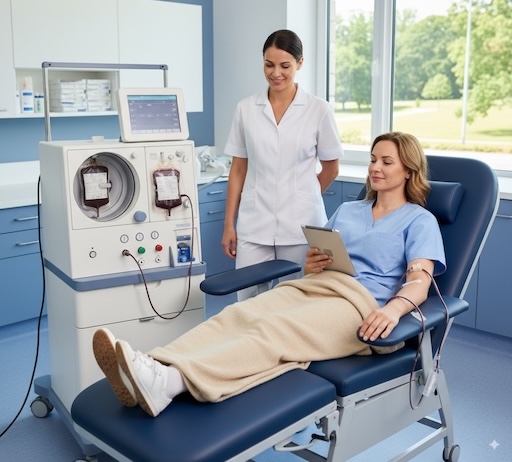
Therapeutic plasma exchange (TPE) removes a patient’s plasma and replaces it with an appropriate fluid (usually 5% albumin or plasma) using centrifugal or membrane-based separation.[1][2] It is an established therapy for selected antibody- or toxin-mediated diseases (e.g., thrombotic thrombocytopenic purpura, myasthenia gravis) and is being explored for age-related applications. Evidence for longevity/biological-age modification in humans remains limited and investigational.[1:1][3][4]
¶ Overview
- What it is: Extracorporeal removal of plasma with replacement fluid to eliminate pathogenic circulating factors.[1:2][2:1]
- Typical clinical use: Autoimmune/antibody-mediated and toxin-mediated disorders per ASFA guidelines.[1:3]
- Longevity bottom line: Preclinical work supports dilution/removal of inhibitory plasma factors; human data for epigenetic-age or lifespan effects are insufficient; use outside approved indications should occur only in trials.[3:1][5]
¶ Benefits (evidence graded)
- Autoantibody/toxin burden — ↓ large — Rapid Ig/complement removal — A (indication-dependent).[1:4][2:2]
- Alzheimer’s disease (AD) symptoms — ↓ decline small-to-moderate — AMBAR albumin/TPE regimen signals in subsets; requires replication — C.[6][7]
- Inflammatory cytokines — ↓ small-to-moderate — Heterogeneous; transient — C.[8][9]
- Lipids/Lp(a) (with apheresis variants) — ↓ moderate-to-large — Technique-specific — B.[10]
- Biological/epigenetic age — Insufficient evidence for effect — F.[3:2][5:1]
Grading rubric: A (multiple high-quality meta-analyses of RCTs); B (several RCTs; generally consistent); C (small/heterogeneous RCTs or observational; mixed); D (limited/low-quality or conflicting); E (preliminary/animal/mechanistic); F (no effect or harm with high-quality evidence).
¶ Drawbacks & uncertainties
- Longevity claims: No peer-reviewed RCT evidence that TPE lowers epigenetic age in humans; preclinical plasma dilution data cannot be assumed to translate.[3:3][5:2]
- Heterogeneous protocols: Volume, frequency, anticoagulant, and replacement vary and affect outcomes.[1:5][11]
- Transience: Removed factors can rebound; durable disease or biomarker changes may require repeated courses.[1:6][11:1]
- Risks: Citrate-related hypocalcemia, hypotension, allergic reactions (plasma), catheter complications; rare serious adverse events (SAEs).[4:1][12]
¶ How it works (mechanism)
- Bulk removal of circulating factors (IgG/IgM, immune complexes, complement, cytokines), reducing pathogenic signaling.[2:3][13]
- Alters proteome/exposome: Replacement fluid (albumin/plasma) changes binding, oncotic pressure, and transport of mediators.[2:4]
- Kinetics: One plasma volume (PV) exchange removes ~60–70% of intravascular constituents; repeated sessions increase cumulative removal.[11:2]
- Preclinical “neutral blood exchange”: Dilution with saline/albumin in old mice reduces inhibitory factors and improves tissue repair/function.[3:4]
- Immune modulation: Indirect effects on B-cell/autoantibody dynamics and complement activity.[2:5]
¶ Dosage information / protocol
- Standard range: 1.0–1.5 PV per session; 5% albumin replacement for most indications; plasma for specific needs (e.g., TTP for ADAMTS13).[1:7][11:3]
- Anticoagulant: Citrate (ACD-A) commonly; monitor ionized calcium; supplement calcium as needed.[4:2][12:1]
- Frequency: Typically 3–5 sessions over 1–2 weeks for many immune indications; maintenance per disease course. Experimental longevity/AD regimens used repeated low-volume exchanges with albumin ± IVIG.[6:1][7:1]
- Access: Peripheral or central venous catheter depending on veins/flow.[1:8]
¶ Dosage at a glance
| Use case | Typical dose/volume | Timing | Notes |
|---|---|---|---|
| Antibody-mediated disease | 1.0–1.5 PV per session | Every 24–48 h (3–5 sessions) | 5% albumin replacement; adjust per labs[1:9][11:4] |
| Hyperviscosity | 1.0 PV | Single or repeated as needed | Consider plasma if coagulopathy present[1:10] |
| Alzheimer’s (experimental) | Low-volume exchanges | Weekly→monthly per protocol | Albumin replacement ± IVIG; investigational[6:2][7:2] |
¶ Safety information (summary)
Common: Peri-procedural paresthesias (citrate), cramps, hypotension, flushing/urticaria (plasma), access-site issues. Avoid in unstable hemodynamics; use plasma when coagulation factors required. Monitor ionized calcium, CBC, fibrinogen, electrolytes; consider infection risk with central access.[1:11][4:3][12:2]
¶ Side effects
| Effect | Frequency/notes | Route | Evidence |
|---|---|---|---|
| Citrate hypocalcemia (paresthesia, tetany) | Common; dose-related; mitigated by calcium | Extracorporeal (citrate) | Probable[4:4][12:3] |
| Hypotension/vasovagal | Occasional; volume/vasomotor related | Systemic | Probable[4:5] |
| Allergic/urticarial reaction | Occasional; higher with plasma replacement | Systemic | Probable[4:6] |
| Catheter-related infection/thrombosis | Infrequent; access-dependent | Vascular access | Probable[4:7] |
| Bleeding (low fibrinogen) | Infrequent; monitor fibrinogen, use plasma if needed | Systemic | Possible[1:12][11:5] |
| Serious adverse events | Rare (<1%); anaphylaxis, severe hypotension | Systemic | Probable[4:8] |
¶ Precautions
| Population/condition | Precaution | What to monitor |
|---|---|---|
| Severe heart failure/unstable hemodynamics | Risk of decompensation | BP, volume status |
| Hypocalcemia risk (low vitamin D, CKD) | Citrate toxicity | Ionized calcium, symptoms |
| Anticoagulation/coagulopathy | Bleeding with albumin-only replacement | Fibrinogen, INR, aPTT |
| Infection risk/central line | Catheter sepsis/thrombosis | Line care, CBC, cultures if febrile |
| Allergy to plasma products | Hypersensitivity | Premedication, consider albumin replacement |
¶ Evidence database (core)
| Outcome | Direction | Effect size (units) | # Studies | # Participants | Evidence grade | Notes |
|---|---|---|---|---|---|---|
| Autoantibody levels | Large (% reduction after 1–3 sessions) | Multiple RCTs/series (indication-specific) | Hundreds | A | Rapid intravascular Ig removal[1:13][2:6][11:6] | |
| AD cognitive decline (AMBAR) | Small–moderate slope change | 1 RCT (multicenter) + extensions | ~300–350 | C | Signal in moderate AD; replication pending[6:3][7:3] | |
| Cytokines (IL-6, TNF-α) | Small | Small RCTs/observational | <200 | C | Transient; protocol-dependent[8:1][9:1] | |
| Lipoprotein(a) (apheresis variants) | Moderate–large | Multiple trials | Hundreds | B | Technique-specific; not standard TPE[10:1] | |
| Epigenetic age | — | Insufficient data | 0 RCTs | — | F | No peer-reviewed RCT evidence in humans[3:5][5:3] |
¶ FAQs
-
Does TPE reverse biological (epigenetic) age?
- No confirmed human RCT evidence. Preclinical dilution studies in mice improved tissue function, but translation is unproven.[3:6]
-
How long do effects last?
-
Can albumin alone (without full plasma exchange) help AD?
-
Who should avoid TPE for “anti-aging”?
- Healthy individuals outside clinical trials; FDA has warned against plasma infusions marketed for anti-aging.[5:4]
¶ See also
¶ References
ASFA Apheresis Committee. Guidelines on the use of therapeutic apheresis in clinical practice—evidence-based approach (2023 update). J Clin Apher. 2023;38(Suppl). PubMed: https://pubmed.ncbi.nlm.nih.gov/37017433/ ↩︎ ↩︎ ↩︎ ↩︎ ↩︎ ↩︎ ↩︎ ↩︎ ↩︎ ↩︎ ↩︎ ↩︎ ↩︎ ↩︎ ↩︎
Reeves HM, Winters JL. The mechanisms of action of plasma exchange. Br J Haematol. 2014;164(3):342–351. PubMed: https://pubmed.ncbi.nlm.nih.gov/24172059/ ↩︎ ↩︎ ↩︎ ↩︎ ↩︎ ↩︎ ↩︎
Mehdipour M, et al. Rejuvenation of three germ layers tissues by exchanging old blood plasma with saline-albumin. Aging (Albany NY). 2020;12(11):8790–8819. PubMed: https://pubmed.ncbi.nlm.nih.gov/32474458/ ↩︎ ↩︎ ↩︎ ↩︎ ↩︎ ↩︎ ↩︎
Winters JL. Complications of therapeutic plasma exchange. Transfusion. 2011;51(8):1781–1801. PubMed: https://pubmed.ncbi.nlm.nih.gov/?term=Winters+complications+therapeutic+plasma+exchange ↩︎ ↩︎ ↩︎ ↩︎ ↩︎ ↩︎ ↩︎ ↩︎ ↩︎
U.S. FDA. FDA warns against receiving young donor plasma infusions that are promoted as unproven treatments. 2019. FDA: https://www.fda.gov/news-events/press-announcements/fda-warns-against-receiving-young-donor-plasma-infusions ↩︎ ↩︎ ↩︎ ↩︎ ↩︎
Boada M, et al. A randomized clinical trial of plasma exchange with albumin replacement (AMBAR) in Alzheimer’s disease. Alzheimers Dement. 2020;16:1412–1425. PubMed: https://pubmed.ncbi.nlm.nih.gov/32715623/ ↩︎ ↩︎ ↩︎ ↩︎ ↩︎
Boada M, et al. Albumin replacement therapy in Alzheimer’s disease: phase II results and post hoc analyses. J Alzheimers Dis. 2017;56(2): . PubMed: https://pubmed.ncbi.nlm.nih.gov/?term=Boada+albumin+replacement+Alzheimer's+2017 ↩︎ ↩︎ ↩︎ ↩︎ ↩︎
Stahl K, Busch M, et al. Therapeutic plasma exchange in sepsis and systemic inflammation: a systematic review. Crit Care. 2020;24:278. PubMed: https://pubmed.ncbi.nlm.nih.gov/?term=therapeutic+plasma+exchange+sepsis+systematic+review+2020 ↩︎ ↩︎
Busund R, et al. Plasma exchange in severe sepsis and septic shock: a prospective, randomized, controlled trial. Intensive Care Med. 2002;28(10):1434–1439. PubMed: https://pubmed.ncbi.nlm.nih.gov/12373468/ ↩︎ ↩︎
Roeseler E, et al. Long-term effects of lipoprotein apheresis on Lp(a) levels and cardiovascular outcomes. Eur J Clin Invest. 2014;44(10): . PubMed: https://pubmed.ncbi.nlm.nih.gov/?term=lipoprotein+apheresis+long-term+Lp(a)+outcomes ↩︎ ↩︎
Kaplan AA. Therapeutic plasma exchange: core curriculum. Am J Kidney Dis. 2013;61(3):371–380. PubMed: https://pubmed.ncbi.nlm.nih.gov/?term=Kaplan+Therapeutic+plasma+exchange+core+curriculum+2013 ↩︎ ↩︎ ↩︎ ↩︎ ↩︎ ↩︎ ↩︎ ↩︎
Mokrzycki MH, Balogun RA. Therapeutic apheresis: a review of complications and management. Transfus Apher Sci. 2011;45(3):160–167. PubMed: https://pubmed.ncbi.nlm.nih.gov/?term=Mokrzycki+Balogun+apheresis+complications+2011 ↩︎ ↩︎ ↩︎ ↩︎
Szczepiorkowski ZM, et al. Guidelines and principles for therapeutic apheresis—ASFA. J Clin Apher. 2010;25(3):83–177. PubMed: https://pubmed.ncbi.nlm.nih.gov/?term=Szczepiorkowski+therapeutic+apheresis+guidelines+2010 ↩︎
Comments
Discussion